Showing posts with label blurb. Show all posts

Wednesday, May 22, 2013

Equipment Plug

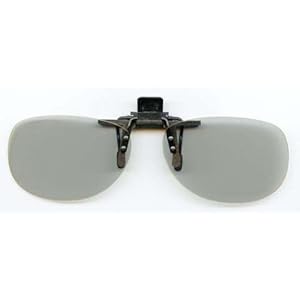
This is just a quick little blurb because I've seen way too many anti-3D people complaining about wearing 3D glasses on top of 3D glasses. That's not a problem, and the reason why is these little guys right here:
These things are the CinePro Clip-on 3D Glasses. I don't personally need glasses, but I bought a pair anyway so I could watch 3D movies with family and friends. But once I recieved them, I actually started wishing that I did wear glasses! These are incredibly comfortable and lightweight, yet sturdy, so that they fit on glasses without much issue. That's not what impressed me, though. Out of curiosity, I tested them out on my 3D TV at home, and to my surprise discovered that they let in an impressive amount of light, addressing the sense of dimness and color fade that 3D glasses are infamous for bringing. If you use glasses, these things will probably put you about $6 in the hole one time, and then 3D movies will be instantly better for you bespeckled folks.
The one downside I can say about these glasses is that one time that I used them, the clip on the top of them snapped. It was possible to fix (without tools), but it was an annoyance that probably should have been avoidable. It's a minor nuisance though, and one that you'll likely not even run into it yourself.
So if you for any reason want or need to see a 3D version of a movie and wear glasses, do yourself a favor and buy these. They're cheap, and they'll make life easier for you.

Thursday, May 16, 2013

Background

You know, it occurs to me that you can't see the image I use for my background very well when you use the image in the context of a background. So I figured I'd provide the picture in a post itself for people to look at, without content redirecting your eye (since the image was a background, I converged so the entire image falls into the screen rather than anything popping out, which you'll recall from my focus/convergence post means the blog content forcefully draws your eye away from the background when you're wearing 3D glasses).

Here's the picture. I took it myself from a park not far from where I live.


As I'm presenting it for closer inspection than as my background, though, I'm starting to get self-concious about the quality of the shot. The only non-cell phone / tablet camera (meaning the only camera I can mount on a tripod) that I own is a Fujifilm W3 Real 3D camera. It's a consumer camera, which unfortunately means a fixed interocular distance at roughly the same distance apart as the human eyes. Unfortunately, that distance tends to de-emphasize depth in landscape shots over miles of distance like we see in this picture. Consequently, I did not rely on the camera's built in 3D capabilities.

What I did was bring my camera and my tripod, set it up to snap the left frame, and then move it around a foot to the right to snap the right frame. I used the tripod to allow for a fixed height of the images so try and combat mismatching images. The ground isn't completely level, as you can tell looking at especially the pipe or the lamp post. It's not a huge violation, and shouldn't be off enough to hurt your eyes too much, but it is something that embarasses me.

Another thing I failed to consider when taking the photo was the moving objects in the frame, specifically the clouds and the smoke coming from the smokestack off in the difference (look closely, and you'll see that especially the smokestack is a different shape between the red and cyan frames). While this makes the smoke look really weird, it kind of worked with the clouds. This shot is facing west, and the clouds were moving north that day, or to the right of this picture. Consequently, the clouds aren't as far apart from each other than the more static objects in the picture, and therefore in the final 3D picture have their depth accentuated more than anything else in the picture. This is definitely an unintended stereoscopic mistake, but I consider it an improvement on the picture rather than an embarrassment like the smokestack, pipe, or lamppost. In this picture, the clouds having unrealistic depth makes them feel like they're not clouds at all, but rather a blanket covering the sky. It's not something I've ever literally seen in life, but it gives the heavens a sense of magic. The fact that it was an accidental only emphasizes that, (although the smokestack cutting into them highlights the fact that this was an error).

All in all, I'm not proud of this picture thanks to all the errors that I know should have been fixable. But they're small, and I appreciate the accidental majesty of the picture. Even so, I'm thinking it might be time to find another picture and switch them up. We'll see what I can do. I'm not making any promises.
Monday, April 8, 2013

Could a simple protective film be the future of glasses-free 3D viewing?

I didn't come up with that title. I stole it from one of those ad-in-disguise news articles that's been going around Malaysian news sources. There's an example here, but I'll give you the gist of what they're saying, and then answer the question from the headline.

Developed in Singapore by Temasek Polytechnic (TP) and A*STAR's Institute of Materials Research and Engineering over the course of two years, the film, called EyeFly 3D and set to go on sale globally in May, contains 500,000 microscopic lenses that can render static and moving images in stereoscopic 3D, yet it is only 0.1mm thick, making it the same size and thickness as traditional screen protectors.
It won't take a user's existing 2D images and films and convert them magically in front of their eyes, but it can take any content shot in 3D and display it as such, without the need for 3D glasses.
They use a lot of numbers and buzzwords to make what EyeFly is doing sound impressive and science-y. And while what they're doing is cool, they are over-hyping their product just a tad by pretending it's a revolution. This is not "the future of glasses free 3D viewing," but a re-application of old technology we've seen in a number of other products (The Nintendo 3DS is the first to come to mind, but less famous examples include the HTC EVO 3D, the LG Optimus 3D, The Fujifilm W3 Finepix 3D Camera, or the sticker covers on the sleeve of 3D Blu-rays).

This technology is what's known as a parallax barrier, in which precisely cut slits in a screen (or ridges in the case of those 3D stickers that 3D Blu-rays use) are used to direct images individually to your eyes. In the case of EyeFly, they've created a film that you can put over your existing smartphone to allow this kind of image separation. They've also created software for the iPhone that will allow you to transform normal stereoscopic video into an interleaved video format that will allow video to play on your phone after you put this film on it (although they're planning an Android version for the Galaxy S2 as well).

It's a technology that works, and a good way to cheaply upgrade from a 2D to a 3D smartphone. It will present the same problems I've previously highlighted with autostereoscopic displays, including the narrow viewing angle, and halving your phone's resolution. Halving your phone's resolution could also affect the text displayed on it, by the way. I'd have to actually see the product in action to know by how much, but difficulty reading is something to look for in reviews and to take into consideration before buying.

But I digress. The conclusion here is that this isn't revolutionary technology. It's economy class technology that will get the job done if you're looking for a cheap 3D smartphone. It is something I'd look into myself (assuming their software ever supports Nexus line Android smartphones and tablets, or some 3rd party makes universal android software for them), but not something I'd recommend without first seeing it in action. EyeFly looks like an interesting product, but that company is really misinforming the public about why their product is so interesting. That makes me suspicious about their ethics as a company, so my advice is to wait for reviews to know if that product is worth buying. Hopefully they just hired a marketing department that doesn't know what they're marketing.

Friday, January 11, 2013

Glasses No Longer Needed

This is just a quick update. You remember how in a previous post I said glasses free 3D TVs hadn't caught on because you could only view them from one angle? Well, I neglected to mention Lenticular displays. See, there's this type of display that can do glasses free 3D from any angle, but it requires a lot more information that two video images, and is not compatible with current dual video films. However, it is now more accurate to say that it was incompatible.

You see, at CES 2013, Dolby demoed a brand new 4k resolution (higher resolution than most theaters currently show movies) lenticular 3D TV that uses internal software to convert stereoscopic inputs into lenticular outputs. In case you haven't been following along with my geek speak, that means there now exists a theater quality 3D TV that you don't need glasses to watch.

It'll probably still feel weird to people with binocular vision problems, but this is really exciting. Dolby have just solved two of the three problems I hear most often when people criticize 3D: The need to wear glasses, and the dimming of the image. Headaches for people with binocular vision deficiencies could still be a problem, but all-in-all, this may be the exact thing 3D needs to make it mainstream (assuming it's reasonably priced).