Showing posts with label 3d. Show all posts

Thursday, July 25, 2013

Dial M For Murder 3D Movie Review

It's common knowledge that there was a 3D Boom during the 50s. It's not as common knowledge that Alfred Hitchcock's Dial M For Murder was among the movies considered part of that boom. And to be honest, I don't blame people for not knowing that. As a thriller that deals more with the tension between scheming people, it flies in the face of popular Hollywood consensus that you need action to make a good 3D movie, as exemplified in quotes like this one by Carl Mazzocone:
"A lot of producers have exploited 3D unnecessarily to capture that extra little [sur]charge at the box office. Certain movies clearly should not be 3D. ... But, in a horror movie where there's action and you're trying to make it as frightening as possible, and of course you're wielding a three foot chainsaw, you have a situation where you can actually enhance the situation by making a 3D movie."
Now, I probably don't need to say more than "directed by Alfred Hitchcock" for you to know that this is a good film by Hollywood standards (or almost anyone's for that matter). He's one of the directors whose work was used as evidence to form auteur theory, after all. But then how do we account for this gross misstep in use of 3D, as per Hollywood convention? The answer is that Hollywood was wrong and Hitchcock was right. 3D works well (if somewhat unconventionally) in Dial M for Murder.

Before I continue, I should note that this review contains some spoilers. You have been warned.

I've written before about how 3D can be used to draw your attention to certain objects by placing them further in the foreground, thanks to the focus/convergence problem. In the introduction to the film, Hitchcock abuses this power. He uses it to draw your attention away from the people in the scene composition, and toward the plethora of things adorning Tony Wendice's home. It's an odd choice, since those things are not the subject of any of these shots, but mimics Tony's greed addled mindset at the time. Dial M for Murder gains most of its suspense from how unlikely it is for Tony's murder plot to succeed, so by using the 3D composition to throw the audience's attention about, whether it be on his accumulated possessions at the beginning, or the things and people set to unfurl his perfect murder plot as the film progresses, makes the audience absorbed in Tony's hatred (almost feeling he's justified), and then riddled with suspense he feels as the story progresses. It's a perfect and a very creative use of the focus/convergence "problem" that 3D video has, and carries the film well to its intended emotional effect.

The film defies 50's 3D film stereotypes in that it makes most of its use of 3D in positive space (going into the screen) rather than negative space (popping out of the screen). There are 3 exceptions to this rule, two of which carry an impactful emotional effect themselves. The one that doesn't is that all of the titles significantly protruded from the screen.
The second is depicted in the murder scene itself. Tony's wife, the victim, lies down on a desk, her neck constricted by her attacker. The camera is positioned such that her hand protrudes out toward the audience very deeply. To many audiences, the impulse here would be to grab her hand, which is an action akin to attempting to save her. It enhances the disgust the audience members feel with the murder's action. The third is when the police officer presents Tony with a key to his apartment. This key later becomes the means to unravelling his murder plot. Again, as this film is shot from Tony Wendice's point of view, this is insightful and emotionally compelling. At the time, it's obvious his story is being called into question, but the pop out again makes the audience feel compelled to reach out and grab the key. They feel the fear of abandoning logic, while knowing their raw emotion at that point forces them to defy it. Both scenes are beautiful depictions of Tony's conflicting emotions, each of which are lessened in the 2D version of the film.

I can wholeheartedly recommend this film in its 3D version. Hitchcock employs the format masterfully, in ways that greatly improve the film over its 2D release. The 3D Bluray has one scene missing the right frames, so it briefly displays in 2D, but other than that is a fantastic restoration of the original film as well (I wonder, though, why they didn't do a 3D conversion on that scene). If you have access to a 3D TV, and haven't already picked this up, you should definitely add it to your collection. I'm glad I did.

Monday, June 24, 2013

Man of Steel 3D Movie Review

I have a hard time thinking of things to post to this blog. It was originally conceived as a way to collect ideas about 3D film in general that I'd previously been posting to Facebook, which one of my Facebook friends suggested this might be better as a blog. There's only so much I can say about 3D generally though, and that's been starting to show with my utter lack of updates (and when I do update, although honest and not paid posts, sound like they are ads). Recently, though, I had the idea of posting reviews of 3D movies I've watched, but that seemed unnecessary as most of the 3D movies I've seen have been out a while already, and most people should know by now what they think of them. I recently managed to find time to see Man of Steel, however, and that's new enough that I figured I'd try and review how good it was as a 3D movie.

The movie itself doesn't depart dramatically from the normal Superman mythos. The narrative structure actually reminds me a lot of Batman Begins, in that the film constantly jumps back and forth between Superman's youth to provide context for how his origin as an Kryptonian alien shapes the hero he is in this grand battle in which he partakes. Exploring Superman in this light, as a Kryptonian sent to Earth, is an aspect of Superman's character that I've never really seen before. It's an impressive look that I suspect some people will find fascinating, especially those interested in the super hero myths as just that: myths.

They really sell Superman as a mythological, even god-like hero. From his origins on Krypton, where Jor-El is given a visual aesthetic that calls to mind the Roman culture (and the casting Russel Crowe as Jor-El brought to mind images of Maximus from Gladiator as well). Jor-El's confrontation with General Zod feels heavily Roman in style as well, lending a rugged and even god-like military masculinity to all of the Kryptonian interactions (in case the close up on Henry Cavill's abs during heavy lifting didn't do that well enough). Even the cinematography, which abandons panic-driven shaky cameras popular in most modern action scenes in favor of jerky, sweeping movements with each hit, causes this movie to bleed masculinity in ways that impressed me. Still, I never really connected that style with versions of the Superman character in previous iterations I've seen of the character, who always seemed more about a cool head giving him control rather than his raw power.

If I had a really major criticism of the film (other than that I didn't believe Lois Lane and Superman's chemistry for a second), it's that Superman is too out of control of the situations he's in. The film treats Superman's birth as the solution to Kryptonian society's obsessive desire to control the destinies of all Kryptonians. Yet Superman's actions always seem directed by his Kryptonian genesis. He even interprets the "S" on his chest under its Kryptonian meaning rather than the earthly interpretation for which it's colloquially known, and which someone raised on earth would be expected to use. My sister, who watched the film with me, also picked up on the inconsistency, and mockingly mimicked Jor-El saying, "You have the right to be who you want to be, now go do what I tell you!"

But of course, this review wouldn't be on this blog if Man of Steel weren't released in 3D, so with that frame in mind, the question is, "How does the 3D lend itself to this movie?" Unfortunately, it doesn't. While I have no technical qualms with the 3D conversion quality, and some of the individual scenes looked magnificent, the film was obviously shot with the intent that it be viewed in its 2D version, and those decisions made some of the stereo work unsalvageable. Handheld cameras used to make the scenes in Kansas, and other smaller towns in which Clark Kent finds himself, are difficult on the eyes, making this movie somewhat likely than others to induce headaches and nausea. Not only that, but there were constant over-the-shoulder shots that lacked any floating windows to ease the eyestrain caused by window violations. These and other extreme closeups resulted in numerous scenes that lacked any notable depth as well, nor did they exploit convergence tricks to do anything special with the stereo conversion for these extreme closeups directly.

I'm going to be honest here, I didn't like this movie. Most of the movie was admittedly very well done, but not to my tastes at all (I prefer my super heroes to be more human, and this one lays the Kryptonian heritage on too strong for me). It also doesn't help me like it that the 3D in this movie was something I can really point to as an example of what 3D looks like when it actually is a superfluous marketing gimmick. It added less to the film than it detracted from it, so I really suggest, unlike what I did, seeing the 2D version of this movie. It's a good movie, if somewhat niche, but only in 2D.

Thursday, June 20, 2013

Is The 3D Price Hike Justifiable?

Before I go into this question, I have to get some things out of the way. I am not an economist. All I really know about economics is the basic supply vs demand rule. Hence, you will need to take what I'm saying here with a grain of salt. I'm just reacting to what I hear the market saying, and wondering out loud if there's a way to appease these oftentimes inconsistent potential consumers of 3D content. This isn't a researched marketing advice column.

That said, the loudest and most valid complaint I hear about 3D content is that it's too expensive, and that potential consumers can't justify the extra price for a 3D version of a show. Admittedly, if I wasn't trying to understand every failure and success that the 3D film medium has to offer by consuming every iota of it that I can, I would take the same approach. Most 3D films (e.g. Wreck-It-Ralph, Star Trek: Into Darkness, Hotel Transylvania) are not actually made to be viewed as 3D content. When a filmmaker makes their film with the 3D version intended as the foremost (e.g. Avatar, Hugo, Life of Pi, The Hobbit: An Unexpected Journey), they can accomplish wonderful things with the format. But if 3D is an afterthought, as it so often is, there is no advantage whatsoever to seeing the film that way, and you're usually wasting your money spending extra on the surcharge.

Maybe there's some chicken and the egg business going on here. The 2D version gets the most attention because that's how the grand majority of the audience is going to see the movie, and the audience goes to see the 2D version because that's obviously the one getting the most attention. But we're getting into my "why 3D content should be shown exclusively in 3D" argument, which I'm not on topic, so back we go to the original topic.

But while the surcharge pushes audiences away, I also understand how cinemas and executives justify the price hike. If you're not going the conversion route that most filmmakers are using these days, you're looking at buying twice as many cameras as an equivalently scoped 2D movie, buying rigs in which to store both of these cameras together, hiring a team of stereographers to keep the 3D from going wrong, and will require twice as much rendering time when you go to put the movie in post-production. Even if you're post-converting to 3D (which is relatively less expensive), you're still looking at delayed rendering, and hiring a (usually outside) company of hundreds of VFX artists rotoscoping objects and filling in black holes created by having to create stereo parallax where it doesn't actually exist. More effort to make the movie means more people to pay, and a greater risk in making the movie. If 3D won't pull extra people into the theaters, you're going to need to surcharge in order to make that money back.

I think that's the problem with their reasoning, though, and the lesson executives didn't learn from Avatar even though it was plainly obvious. Everyone was talking about the 3D film experience when Avatar came out. It was something unique that you had to experience. And 3D was the primary draw of the film, despite the surcharge. Yet Hollywood seems to believe that it's the Ferngully meets Pocahontas plot and characters that drove that movie to success, and that the 3D was just there to draw a few more dollars out of a standard audience.

My position is that 3D can carry itself, and that therefore they shouldn't charge more for it. It helped draw people in to see Life of Pi and Avatar, two films interesting for how they utilized their 3D techniques. That should be enough to justify the increased cost to production. 3D shouldn't be added to a movie if it's not going to help it tell the story it's trying to tell, but more movies can and should use it in their storytelling. This will draw in audiences, increasing income without increasing the ticket price of a 3D film. 3D ticket prices should be the same as their 2D equivalent to draw more people in.

Again, I'm not an economist, and given the 15-20% increase in 3D movie production costs, and the need for theaters to create 3D compatible screens, train employees in 3D exhibition (though that doesn't always work), and buy extra digital storage, I can really see why they feel they need a 30% increase in price vs. a 2D ticket. But the first theater to do away with the 3D surcharge I think will make that money back by seeing an increase in movie attendance, which is what Hollywood really needs right now. Despite a 30% increase in average movie ticket prices overall over the last decade, they've only seen a 17% increase in income (and that's with the boost 3D gave, according to MPAA statistics). This means Hollywood is making less money because of lesser attendance. They need a way to draw people back into theaters, and they're killing their first good answer to this problem by pricing people out of it!

It might actually be too late. So many people have derided 3D for the marketing gimmick Hollywood wanted it to be that audiences may be unable to accept that 3D can be used for non-manipulative purposes. Hollywood may have killed their chance. But there's so much untapped potential to 3D, I seriously hope not.

Thursday, June 13, 2013

ESPN 3D Dying Doesn't Mean 3D is Dead

Check out these headlines:

Was 3-D TV a failure? ESPN to end broadcasts
Is 3D TV dead? ESPN 3D to shut down by end of 2013
3DTV Is Officially Never Going To Happen

I keep a newsfeed about 3D film and 3D movies on Google News, and this story has been popping up repeatedly this morning. ESPN 3D has decided they can't continue broadcasting because there's not enough demand for their channel. To be honest, from what I've seen of ESPN 3D in Best Buy 3D TV demos, it doesn't surprise me at all. Their broadcasts consist largely of sports commentary, and one to five grown men talking to you while sitting in an otherwise empty room hardly makes for compelling stereography. Not to mention, many their advertisers really cheaped out on their ads' 3D conversions, resulting in ad time that's a physically painful experience. Some of the sports footage looked kind of neat in 3D, but on active sets you're also halving the frame-rate of broadcasted content, which is going to be very obvious in the fast paced action of sports. The unpredictability of sports also means you're going to be running into uncorrectable problems with the focus/convergence issue. Basically, anybody with any sense in stereographic broadcasting could have told you long before ESPN 3D went live that live sports with 3D ads was going to be a colossal failure.

The problem is that, apart from a promotional channel that Comcast runs to promote their 3D package, ESPN 3D was the only 3D television channel that exists in the United States. Because that effectively killed 3D broadcast stateside, news commentators have jumped to the conclusion that 3D content is unmarketable, and so 3D TV is going to die on the vine in favor of 4K content. Here's why the doomsayers are wrong about 3D TV dying.

I readily admit ESPN was a terrible fit for 3D, but TV is in a situation where they more or less need 3D to work. TV viewership is down generally, especially among younger generations, which projects poorly for the future of broadcast television vs their primary competitor, Internet content (Netflix, YouTube, etc.). One need only look at things like Google Fiber vs Comcast net speeds to see that ISPs can match broadcasters tit for tat in anything that's simply about the amount of information sent (like the resolution increment to 4K). Instead of pushing through a different quantity of data, making 3D content available changes the type of data they're pushing through to something competitors will require time adjusting to. It's like how Apple made a huge dent into the computer market with the iPhone. There was no way into the traditional computing market, so Apple created their own markets in the mobile space and dominated them. 3D is an unclaimed market, while 4K is just an iteration on the same market cable is losing to the Internet.

Some will argue with that by saying that there's no point in creating a market if there's no demand for that market once created. But we don't have enough evidence to say 3D is a low-demand market. For one, 3D TVs haven't fully matured yet. Glasses free lenticular 3D TVs are set to premiere in the near future, which is a technical achievement that will rejuvenate the 3D market if it debuts at a reasonable price. Another point is that 3D content has been proven to have a sizable market interested in the 3D aspect, as evidenced by Avatar, The Avengers, and Life of Pi (all of which did tremendously well in their 3D exhibitions). The problem is not a lack of demand, rather the immaturity of the market.

Perhaps someone will argue that we've spent too long in the infancy of 3D, that the market has been ruined, and will never come back. These people haven't seen Nintendo's market take technology out of infancy to great market appeal. They'll know about the Wii, but they won't connect that it's an iteration on the technology of the Power Glove. The Power Glove was a failure critically and commercially. The Wii wowed the world at its release. Yet both were motion based controls for video games using infrared sensors to detect the controller in space. The Wii just had improved technology. 3D currently suffers from a lot of incompetency in its production, as Clash of the Titans or ESPN 3D's ads could easily prove. What we're seeing is too often like somebody pretending student films represent a permissible standard for film or television in general. It's simply put an immature market full of people learning the ropes of 3D video.

Will 3D TV make a comeback? Only time will tell for certain. But it's certainly foolhardy to declare it dead just because a single channel couldn't forge a new market with a bad entry to it.

Wednesday, May 22, 2013

Equipment Plug

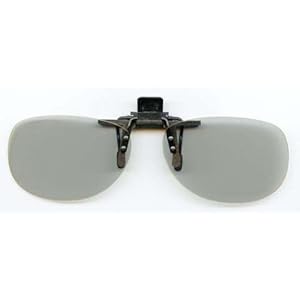
This is just a quick little blurb because I've seen way too many anti-3D people complaining about wearing 3D glasses on top of 3D glasses. That's not a problem, and the reason why is these little guys right here:
These things are the CinePro Clip-on 3D Glasses. I don't personally need glasses, but I bought a pair anyway so I could watch 3D movies with family and friends. But once I recieved them, I actually started wishing that I did wear glasses! These are incredibly comfortable and lightweight, yet sturdy, so that they fit on glasses without much issue. That's not what impressed me, though. Out of curiosity, I tested them out on my 3D TV at home, and to my surprise discovered that they let in an impressive amount of light, addressing the sense of dimness and color fade that 3D glasses are infamous for bringing. If you use glasses, these things will probably put you about $6 in the hole one time, and then 3D movies will be instantly better for you bespeckled folks.
The one downside I can say about these glasses is that one time that I used them, the clip on the top of them snapped. It was possible to fix (without tools), but it was an annoyance that probably should have been avoidable. It's a minor nuisance though, and one that you'll likely not even run into it yourself.
So if you for any reason want or need to see a 3D version of a movie and wear glasses, do yourself a favor and buy these. They're cheap, and they'll make life easier for you.

Thursday, May 16, 2013

Background

You know, it occurs to me that you can't see the image I use for my background very well when you use the image in the context of a background. So I figured I'd provide the picture in a post itself for people to look at, without content redirecting your eye (since the image was a background, I converged so the entire image falls into the screen rather than anything popping out, which you'll recall from my focus/convergence post means the blog content forcefully draws your eye away from the background when you're wearing 3D glasses).

Here's the picture. I took it myself from a park not far from where I live.


As I'm presenting it for closer inspection than as my background, though, I'm starting to get self-concious about the quality of the shot. The only non-cell phone / tablet camera (meaning the only camera I can mount on a tripod) that I own is a Fujifilm W3 Real 3D camera. It's a consumer camera, which unfortunately means a fixed interocular distance at roughly the same distance apart as the human eyes. Unfortunately, that distance tends to de-emphasize depth in landscape shots over miles of distance like we see in this picture. Consequently, I did not rely on the camera's built in 3D capabilities.

What I did was bring my camera and my tripod, set it up to snap the left frame, and then move it around a foot to the right to snap the right frame. I used the tripod to allow for a fixed height of the images so try and combat mismatching images. The ground isn't completely level, as you can tell looking at especially the pipe or the lamp post. It's not a huge violation, and shouldn't be off enough to hurt your eyes too much, but it is something that embarasses me.

Another thing I failed to consider when taking the photo was the moving objects in the frame, specifically the clouds and the smoke coming from the smokestack off in the difference (look closely, and you'll see that especially the smokestack is a different shape between the red and cyan frames). While this makes the smoke look really weird, it kind of worked with the clouds. This shot is facing west, and the clouds were moving north that day, or to the right of this picture. Consequently, the clouds aren't as far apart from each other than the more static objects in the picture, and therefore in the final 3D picture have their depth accentuated more than anything else in the picture. This is definitely an unintended stereoscopic mistake, but I consider it an improvement on the picture rather than an embarrassment like the smokestack, pipe, or lamppost. In this picture, the clouds having unrealistic depth makes them feel like they're not clouds at all, but rather a blanket covering the sky. It's not something I've ever literally seen in life, but it gives the heavens a sense of magic. The fact that it was an accidental only emphasizes that, (although the smokestack cutting into them highlights the fact that this was an error).

All in all, I'm not proud of this picture thanks to all the errors that I know should have been fixable. But they're small, and I appreciate the accidental majesty of the picture. Even so, I'm thinking it might be time to find another picture and switch them up. We'll see what I can do. I'm not making any promises.

Thursday, May 9, 2013

Ranty McRanterson

I was just reading something, and I got absolutely set off in a tizzy of nerd rage. What's worse is that it's an insignificant little blurb in an article nobody has read. It's just so sure of itself, yet so unsupportable. I can't seem to shake it. So, if you'll bare with me a moment, I need to get this off my chest by ranting about it here.

What I'm complaining about is Charlie Gates' rant from here, and specifically the part that says this:
Let's face it, 3D is rubbish and pointless. It makes films gloomy, it's distracting, slightly headache-inducing, doesn't add anything to a film, miniaturises everything and takes you out of the film. Like I said, rubbish.
Now, I've already pointed out several ways on this Red/Cyan Movies that the first sentence is wrong, but I'm going to repeat myself anyway. 3D allows the director to forcefully direct the viewer's eye toward objects he deems important (a great way to suggest something is a coverup, or mandate that "can't look away" feeling, which makes it useful for mysteries or love stories). 3D asserts the reality of the scene before you (valuable in something like Life of Pi where identifying what is real is thematically important to the story). 3D provides a frame for the audience to understand their relation to the film, or to become a character in it so to speak (which Batman: Arkham City used to great effect). Emphasized depth can create a sense of vibrancy to a scene (like in Coraline, where it was used to make the other world feel exciting compared to Coraline's boring real home).

Things like these may not be applicable in every situation (I've always said Inception wouldn't have worked in 3D because of the face that 3D asserts reality, which would make the dream world logic feel artificial and wrong), but a generalized statement like "3D is rubbish and pointless" is not a supportable claim when it has worked so tremendously in as many films (and other media) as it has worked. But that only address his claim that 3D is pointless (a claim which he never supports). Let's dissect his support for the claim that 3D is rubbish.

His first complaint is that it "makes films gloomy[.]" First off, he just said 3D was pointless, but gloominess would be a positive in situations like we find in The Corpse Bride, Coraline or James and the Giant Peach... there are a lot of well liked films for which gloominess would be a plus. In that way, he just contradicted himself, because that leads to the conclusion that these films are too muted in gloominess due to their lack of 3D. Of course, I'm nitpicking because I know what he really meant was that there's a color fade and light loss caused by the reflective screens and 3D glasses. Thing is, that's easy to compensate for, and is compensated for in good theaters by the inclusion of brighter projectors and better screens. The argument that 3D films are gloomy is akin to me saying that 2D films click too much because the only 2D films I see are in a second run theater with loud projectors. It's not fair to blame bad exhibition on the film itself!

His next complaint is that 3D is "distracting[.]" I think what he means is that it calls attention to itself, pulling you out of the movie. I want to debunk this two ways. First, by citing Mark Kermode's review of Toy Story 3, where he declared that it did something he didn't think was possible, by making him "forget [he] was watching a 3D movie." This speaks to the idea that it's technique that causes 3D to call attention to itself, not the format itself (which also becomes less naturally novel and self-exerting as audiences get used to it). That said, calling attention to itself is not something bad in all cinematic experiences. Nobody would declare the use of color in The Wizard of Oz to be poor because it calls attention to itself, nor would they do so for the similar use of sound in The Jazz Singer (1927). It's not "distracting," but enhancing in situations where a gimmick intelligently calls attention to itself.

He then complains that 3D movies are "slightly headache inducing[.]" Headaches from 3D film are mitigated entirely in normal people by good stereography. They're not a problem that should delegitimize 3D film any more than motion sickness from shaky cameras should delegitimize film as a whole. There are a portion of people who literally cannot see 3D movies due to stereoscopic vision problems, but killing the 3D film industry for that reason has always seemed similar to nixing film soundtracks on behalf of the deaf, or like closing 5 Guys Burgers to protect people with peanut allergies. It's not necessary to kill an industry just because there's a demographic that can't experience it for medical reasons.

When he says 3D "doesn't add anything to the film," he's just him repeating himself about something I've already addressed, so I'm going to skip to his claim that 3D "miniaturises everything[.]" This one puzzles me the most, especially since the film he's commenting on, Jurassic Park, was a perfect example of how large and threatening big things can be in 3D (especially the first scene with the T-rex). I Googled his claim to see what support I could possibly find for that statement, and instead found that article was the number one result, with a retracted statement by Guillermo Del Toro regarding Pacific Rim as the only statement competing with his own. Aside from the statement being retracted (because it was about why Pacific Rim wouldn't be 3D, when it ultimately was converted to 3D), What Del Toro was talking about wasn't applicable to all situations. His complaint was that when shooting in 3D, your interocular setting is representative of the point of view you're using in the film. But with the size of the monsters in Pacific Rim, you need to switch away from the human view in order for the monsters to have any discernable depth, due to a reduction of parallax on far away objects when using settings that mimic a human point of view. Normal films, not films like Pacific Rim, don't have these stingy viewing requirements (which, again, I point out that Del Toro resolved with the use of 3D conversion as opposed to 3D filming, and hence retracted his statement). 

I'm also going to skip "takes you out of the film" because that seems like it's rehashing what he said about 3D being "distracting[.]" And that pretty much covers this ridiculous statement. All that's left is a smug reaffirmation of that garbage. That smugness is the reason that this post turned as ranty as it did. I would be fine if people would just not like 3D and be done with it. But some cinephiles seem to be on this holy war to destroy stereoscopy, even though nobody's forcing them to attend 3D showings. It's ridiculous that I can't be allowed to enjoy 3D movies just because the mere existence of a format they don't understand and therefore don't like exists! But I digress. I better just stop before this turns into a novel.

Monday, April 8, 2013

Could a simple protective film be the future of glasses-free 3D viewing?

I didn't come up with that title. I stole it from one of those ad-in-disguise news articles that's been going around Malaysian news sources. There's an example here, but I'll give you the gist of what they're saying, and then answer the question from the headline.

Developed in Singapore by Temasek Polytechnic (TP) and A*STAR's Institute of Materials Research and Engineering over the course of two years, the film, called EyeFly 3D and set to go on sale globally in May, contains 500,000 microscopic lenses that can render static and moving images in stereoscopic 3D, yet it is only 0.1mm thick, making it the same size and thickness as traditional screen protectors.
It won't take a user's existing 2D images and films and convert them magically in front of their eyes, but it can take any content shot in 3D and display it as such, without the need for 3D glasses.
They use a lot of numbers and buzzwords to make what EyeFly is doing sound impressive and science-y. And while what they're doing is cool, they are over-hyping their product just a tad by pretending it's a revolution. This is not "the future of glasses free 3D viewing," but a re-application of old technology we've seen in a number of other products (The Nintendo 3DS is the first to come to mind, but less famous examples include the HTC EVO 3D, the LG Optimus 3D, The Fujifilm W3 Finepix 3D Camera, or the sticker covers on the sleeve of 3D Blu-rays).

This technology is what's known as a parallax barrier, in which precisely cut slits in a screen (or ridges in the case of those 3D stickers that 3D Blu-rays use) are used to direct images individually to your eyes. In the case of EyeFly, they've created a film that you can put over your existing smartphone to allow this kind of image separation. They've also created software for the iPhone that will allow you to transform normal stereoscopic video into an interleaved video format that will allow video to play on your phone after you put this film on it (although they're planning an Android version for the Galaxy S2 as well).

It's a technology that works, and a good way to cheaply upgrade from a 2D to a 3D smartphone. It will present the same problems I've previously highlighted with autostereoscopic displays, including the narrow viewing angle, and halving your phone's resolution. Halving your phone's resolution could also affect the text displayed on it, by the way. I'd have to actually see the product in action to know by how much, but difficulty reading is something to look for in reviews and to take into consideration before buying.

But I digress. The conclusion here is that this isn't revolutionary technology. It's economy class technology that will get the job done if you're looking for a cheap 3D smartphone. It is something I'd look into myself (assuming their software ever supports Nexus line Android smartphones and tablets, or some 3rd party makes universal android software for them), but not something I'd recommend without first seeing it in action. EyeFly looks like an interesting product, but that company is really misinforming the public about why their product is so interesting. That makes me suspicious about their ethics as a company, so my advice is to wait for reviews to know if that product is worth buying. Hopefully they just hired a marketing department that doesn't know what they're marketing.

Friday, February 8, 2013

3D Realism


There's an idea that I've been meaning to test (but have never got around to). It has come from a few thing. First, nearly everyone I've interviewed seems to believe that 3D makes an image appear more realistic. Technically speaking, that's not true (there are so many ways that 3D film differs from the way we see 3D objects in real life that I intend to exploit in anything I make), but the fact that people have this sensation is why 3D is generally perceived to only be good for action and horror films (which is ludicrous when you consider the success of films like Hugo and Life of Pi, but I digress).


Second, I realized at one point in my life that my favorite film, Inception, would only work in 2D. This is in no small part because of the Penrose Steps sequences in that film. The Penrose Steps are an impossible staircase that can be drawn in a 2D space to look like they're infinitely descending, because they use inconsistent depth cues to create the illusion of descending. It's impossible to recreate in a 3D space without actually altering the depth. That's the reason it wouldn't work in Inception. Inception was based around existing in a dream world where the logical rules of existence are suspended and replaced with dream logic. The Penrose Steps can exist in this kind of warped logic world because they are impossible but appear possible, which gives the feel that even the impossible is possible that the Inception dream world needs. If converted to 3D, the warping depth needed to create them would both stand out like a sore thumb and call attention to the impossible dream logic, so that it is no longer immersing you in the dream world. 2D doesn't have these limitations, since the Penrose steps can safely exist in a 2D world.

Third, I noticed simply from writing this blog how difficult it is to think about objects in 3D. I don't entirely understand it. I know I watched Finding Nemo in 3D. But every time I think about it, images from a 2D version of that film pop into my mind. It makes thinking about, dissecting, and analyzing stereography require accessing a memory about how I felt about what I was seeing rather than actually recalling the scene composition itself (which is really hard to do, by the way). Eventually I came to the conclusion that this means that while I see things in 3D, I think about things in 2D. I also regularly browse YouTube videos for criticism of 3D to debate, and one of the most mystifying claims people make is that, when they think about it, they don't really remember being wowed by the 3D after the initial wow factor wore off. I take them at their word, but I place more emphasis on the remember factor. I do know from watching 3D that the 3D images never disappear, so I'm led to conclude that people lose the concept of how wonderful a 3D image is because it's only possible to experience 3D, not recall it from memory.

The broader conclusion from all 3 observations is that people react to 3D films in a different way than they do with 2D films. Perhaps this is what people refer to as immersion, but I would describe it differently. In my mind, 3D films make you feel like you're watching something that actually happened, while 2D films make you feel like you're recalling something somebody told you. Put another way, 3D films make you feel like you're actually there for something, while 2D films feel like a memory. This means that 2D films are wholly capable of immersing you in their world, story, etc. But they embed themselves in you like an out of body experience. 3D films don't do this. Rather than feeling displaced in time, 3D makes everything feel current, real, and impactful in a more direct sense than the general human approach that 2D film provides.

To test this, I want to make a 3D film that incorporates both 2D and 3D footage. I wouldn't be the first to do this, but I've never seen anybody else do it this way. I once saw a low budget 3D film from the CMF3D film festival that combined 2D and 3D footage, but I felt like they did it backwards. In their film, called "Collapse," a man takes a drug that causes him to start hallucinating, with the hallucinated world presented as 3D footage (with no other differences). It felt wrong, because the 3D footage felt more real, and his insistence that he was damaged for seeing things this way seemed counter-intuitive and made the less realistic feeling 2D images stick out more than the hallucinations (which were supposed to be the weird part). Instead, I want to make a film that uses 2D to directly convey the idea that some scenes are thoughts, or visions and imaginings. If I'm right, the 2D images will not stick out the way they did in Collapse, but instead flow and create the sensation that you're thinking about things when the 2D hits, and experiencing things when the 3D hits.

Right now, though, this is only a theory. I need people willing to work with me on this experiment, but so many people have been turned off of 3D lately that nobody else seems interested in making this thing. However, if I can find a group to work with me on this, and it turns out I'm right, it could be a very helpful step toward creating a definitive 3D film grammar. Imagine all the questions this could answer about why 3D works or doesn't work in a given title! Imagine how much more useful this would make 3D as a tool for a filmmaker!

If you've ever asked me, I've always said that 3D movies should be shown exclusively in 3D, and 2D movies exclusively in 2D. The reason why is that I have thoughts like this one about 3D and realism vs 2D and imagination that make it seem that certain techniques just don't work in both mediums, and that both 2D and 3D film are both being held back from their full potential by being forcefully shown in both formats. But that's a topic for another day. For now, I'm just thinking about techniques, and wondering if this one I've never seen before would be valuable.

Thursday, January 31, 2013

The Value of Negative Space

It's been a while since my last update. I have been working on this blog; I've just scrapped everything I've posted because none of it has been good enough yet. Hopefully this won't be another post like that, because whether it is or not I'm posting it anyway.

First, a little context for what I'm talking about. In 3D film, you have the ability to render objects in front or behind the screen. In order to be able to describe the things in front and behind the screen, stereographers needed a way to address 3D space. They decided to name the space behind the screen, "positive space," because it increases the amount of space between the audience and the object. Conversely, everything that gets closer to the audience, or "pops out" of the screen, is said to be in the "negative space." I bring this up because there's been this trend lately to deem any use of negative space as "gimmicky." But such a blanket statement is too closed-minded. There are so many reasons that negative space can and should be utilized in 3D movies!

Now, I'm not talking about the lowbrow reasons, meant just for the fun of seeing things protrude from the screen that you can then touch. I should clarify. When I say lowbrow, I mean appeal entirely for the novelty. Things like the scene early in Journey to the Center of the Earth where the lead character spits into a sink, just so the water can splatter well in front of the screen. With time, the novelty of this effect fades. The thing is that these shots aren't always inherently meant for the purpose of novelty, and should not be resisted just because they exist.

Not All Popout Was Meant to Be Gimmicky

The first reason I say this is because of the 3D version of Finding Nemo (which not enough people have seen). If you've seen either version, you'll recall that early in the film, there's a scene where Marlin is exhibiting some comical cowardice by over-cautiously exiting and entering the sea anemone where he lives. The shot is framed so that, in the 3D version, Marlin and Nemo swim from out of the anemone and into the negative space. Conventional wisdom of 3D films would suggest that this scene must have then been shot to exploit the novelty of the 3D effect. While it does exploit it (very amusingly, I might add), the idea that it was framed specifically to exploit it is absurd. Finding Nemo was originally created as a 2D film, and then was later re-rendered in 3D as an afterthought to capitalize on the new 3D boom. They never originally intended that scene to be experienced in 3D. Hence, it couldn't have been composed specifically for 3D. It's just the most logical way to frame that scene, whether in 2D or 3D.

3D Framing Effects an Emotion

But more than just negative space occasionally making the most sense, negative space can be used to positive effect (if you'll pardon the pun). First, because negative space literally brings an object closer to the viewer. This enables filmmakers to have a tool in their tool belt that typically has been only available to theatrical productions; position away from or close to the audience. That may seem unimportant at first glance, but how close a person or thing is to you affects your emotions toward them. If they are further away than it seems they should be, they feel emotionally unattached, withdrawn from your world (to use a word that applies both literally and emotionally, they appear distant).  But if they're too close to you, they feel invasive, and you feel uncomfortable.

Let's take, for example, Hugo (a rightly celebrated champion of 3D cinema). There is a scene in which the titular character, Hugo, is confronting a grumpy toy maker to retrieve a journal that the toy maker had taken away. He instead finds that the toy maker has burned his journal. To compose the emotion of this scene in 3D, Martin Scorsese decided it would be useful to show a scene where Hugo is holding his ashen journal out into the screen, the camera facing upward, and the ashes floating into the negative space. The ashes come extremely close to the viewer (uncomfortably so). This sense of discomfort is then subconsciously transferred back onto Hugo, with whom we empathize at the loss of his journal. It's a beautifully composed scene, which doesn't work as well in 2D, and most certainly wouldn't be possible if 3D were forbidden to utilize negative space, as so many critics are calling for in their haste to declare 3D a useless gimmick.

Involving the Audience

Another valuable use of negative space is the mere fact that negative space is the area that the audience inhabits. Hence, unless a floating frame is negating that effect, using the negative space is a way to invite the audience to explore their own role in the events unfolding on screen. I discovered this when playing the video game, Batman: Arkham City. There's a scene in which Batman confronts Mr. Freeze about creating an antidote to a poison that the Joker used to poison Batman. Mr. Freeze decided to use antidote as leverage to force Batman into serving his own goals. Mr. Freeze crescendos his power over Batman by dramatically holding the antidote in front of him while he crushes it. The 3D version frames this so that Mr. Feeze's hand and the antidote reach in front of the screen. The first time I played, I subconsciously decided to try and reach for the antidote, as taking the role of Batman in this scene made me feel desperate. But I wasn't quick enough. Mr. Freeze crushed the antidote between my fingers. I played again at a later date and was a little quicker that time. Even then, however, my fingers passed right through the vial. Either way the message was clear. Despite my best efforts, that vial was unobtainable. I was weaker than Freeze, and that makes me desperate.

Not every situation is identical to the one in Arkham City, but there are plenty of situations in which a filmmaker may want to include the audience in their film world by utilizing negative space. Perhaps they want to create a similar helplessness by showing failure to grab an outstretched hand in negative space. Perhaps they want to invite you into the magic of a birthday cake's candles by holding it close enough for you to blow them out yourself. It all depends on the script. But the point is filmmakers and critics do film a disservice by immediately declaring all use of objects protruding into negative space to be gimmicky. Negative space is potent when applied judiciously. And, to be honest, I'd like to see more of it.

Friday, January 11, 2013

Glasses No Longer Needed

This is just a quick update. You remember how in a previous post I said glasses free 3D TVs hadn't caught on because you could only view them from one angle? Well, I neglected to mention Lenticular displays. See, there's this type of display that can do glasses free 3D from any angle, but it requires a lot more information that two video images, and is not compatible with current dual video films. However, it is now more accurate to say that it was incompatible.

You see, at CES 2013, Dolby demoed a brand new 4k resolution (higher resolution than most theaters currently show movies) lenticular 3D TV that uses internal software to convert stereoscopic inputs into lenticular outputs. In case you haven't been following along with my geek speak, that means there now exists a theater quality 3D TV that you don't need glasses to watch.

It'll probably still feel weird to people with binocular vision problems, but this is really exciting. Dolby have just solved two of the three problems I hear most often when people criticize 3D: The need to wear glasses, and the dimming of the image. Headaches for people with binocular vision deficiencies could still be a problem, but all-in-all, this may be the exact thing 3D needs to make it mainstream (assuming it's reasonably priced).

Tuesday, January 8, 2013

Go Read This Other Post

I just did a guest post on another blog. This is it. Go read that, please. It might as well be posted here.

Friday, December 28, 2012

On Floating Windows

Last time, I posted an article about a Creative COW article written by Brian Gardner on the 3D process. In it, he touched on something I didn't recognize that he claims to have invented: floating windows. The topic fascinated me, which may be showing some of my inexperience in the field of 3D film making. I've been unable to experiment with creating them myself yet, so take what I say with a grain of salt, but I've since been watching content with 3D windows, and I think I can explain what they are, why they're used, and why they work.

Basically, the problem they're meant to solve is 3D window violations. This is when a portion of a scene has an object that pops partially outside the screen. This will cause half of an image to be floating there outside the screen, ruining the immersion of the image by calling attention to the fact that 3D is an illusion (the first 3D film I ever saw was Clash of the Titans, which had this problem frequently, initially turning me off of 3D in general). Basically, this will happen any time that an object is partially obscured by the screen.

But Brian Gardener once mistakenly discovered that in 3D cinema, the screen doesn't necessarily need to be fixated in one place. So what if we used 3D cinema to actually move the visible theater screen outward, overcoming window violations because things popping out of the screen aren't popping out of this digital screen anymore?

Apparently, you can do this by cropping the edge of the screen in one frame (either by adding black triangles to a corner, or by adding a black line down the side of a screen). 3D creates depth by creating a physical distance separation between an image sent to the left eye, and one sent to the right eye. By adding a triangle to the corner of the screen in only one frame, or by cropping away a portion of it, the screen itself seems to float out into the audience as well (because the corner is now separated by as much . If you separate the edge of the screen as much as the window violation pops out, then it'll seem like the window violation fits nicely inside the screen. And according to Brian Gardener, if you're changing this effect throughout the film, nobody will notice that it's there.

This seems like a very effective way to fix poorly framed footage, or scenes that couldn't be framed differently due to physical limitations (e.g. a documentary, where you can't move the objects in the scene). It also seems like a useful tool in the tool-belt of someone converting a 2D film to 3D (ala Finding Nemo, Star Wars ep. 1, Titanic, where 3D considerations couldn't be made for the film beforehand).

Anyway, that's what I've been learning about 3D imaging recently. I still need to actually use this technique in my own 3D editing in order to understand all the effects here. It seems like it would be a downgrade, since it's literally removing image information. Although, that's not necessarily always a bad thing. But it seems like something that needs to be understood and considered appropriately for that aspect when you're going to use it, and just frame things for 3D in other situations. Also, I'm not sure how to end this post, since I'm mostly just pondering out loud at this point, but I just did it.

Wednesday, December 26, 2012

Brain Gardner Is Doing It Right

I recently read an article by Brian Gardener for Creative Cow Magazine. It's an amazing article that does a lot to explain some of the things I've been unable to adequately explain in previous posts on this blog. But more than just establishing himself as a very competent authority on 3D film-making, the article also brought up a very interesting concept about dynamic floating windows. I'm not entirely sure what he means, so I intend to watch more of his work and pay attention for this concept.

What's particularly interesting to me is his filmography includes two movies thought to be masterpieces of stereoscopic cinema: Coraline and Life of Pi. The article references a live action film in the planning stages that utilizes a technique he pioneered, and given the recent release of Life of Pi and how long the article has been up, I think that may be referencing Life of Pi, which so successful that even 3D critic Roger Ebert praised the use of 3D in it. Having not personally seen Life of Pi yet (and I may have to wait until the Bluray is released to see it, because it's no longer playing in 3D in my area), I am indeed very curious of how important that technique is.

What he describes is something he calls a "Dynamic Floating Window," which because I haven't seen it is something of a mystery to me. He talks about a short film called The Black Swan that tried to keep the audience separate from the onscreen action by creating a floating black screen, effectively creating a new theater screen in front of the actual screen. In that way, it would fix something called a "window violation," where only a portion of an object protrudes from the screen. The problem was audiences noticed this new screen and found it ridiculously distracting, causing more problems than it solved.

Brian Gardener says he tried using this idea with a moving screen instead of a flat one, and suddenly nobody noticed the floating screen anymore. It was still solving problems, but it wasn't causing them anymore. To be honest, it sounds too good to be true, so I'm very curious if I'm just misunderstanding what he's describing, or if what he's describing really accomplishes all he says it does without being distracting. Based on the reviews given to the 3D in his work, it's promising.

Friday, December 21, 2012

3D TVs Are Confusing

This blog is mostly meant to be an opinion blog. This post will probably be a little different. I'm going to get into my opinion on things a bit later, but to start off I need to just explain the technical details of how 3D TV works, because to understand my opinion on them, you need to first understand how unnecessarily complicated 3D TV buying is.
3D is usually done in one of 4 different ways on TV: anaglyph, active shutter, passive, or auto-stereoscopic.


  • Anaglyph. For starters, I'll be talking about anaglyph, since it's the cheapest and most familiar form of 3D that people are aware of. Heck, this blog's name is a reference to the anaglyph method of creating 3D images, and my blog's background (at the time of writing this post) is an anaglyph image. Anaglyph takes an image, and filters its colors so that you can use colored lenses to separate the images and send one to each eye. The way it works is that the colored lenses filter out all the light of a specific color set (usually red for one eye, and the combined blue-green color, "cyan," for the other eye), making it so that only one color goes to one eye, and all the other colors go to the other. The advantages of this method are that it is dirt cheap. You can buy red/cyan glasses on Amazon for around $3, and even that's ridiculously overpriced since many 3D DVDs will give away colored 3D glasses with the movie for free (e.g. Coraline, Ice Age 4, Journey to the Center of the Earth). Aside from being utterly expendable, anaglyph 3D also allows full resolution images to be sent to each eye. Anaglyph images are also the most mobile, as they don't require a special TV to use, or for that matter a TV at all (Anaglyph is the only form of stereoscopic 3D that works on printed paper, for reasons I'll get into later). The disadvantages are that this format stresses your eyes in ways other formats don't, since it's sending conflicting images (due to the different colors) to each eye. Also, because it's filtering colors, it makes the final image appear to be colored differently. It also means that the effect can be ruined and cause excessive ghosting (seeing double images) if the color on your monitor/TV are a little off. Wherever possible, people today avoid using this type of 3D imagery for TVs.
  • Active Shutter Active Shutter TVs were the first 3D TVs to start appearing on the market. The exact date depends on what you want to say qualifies, but these became something regular people could buy without specifically looking for them around 2009, in response to the popularity of Avatar. The TVs themselves are different than regular TVs because, rather than the standard 60 Hz refresh rate that regular TVs have, which means they max out at being able to display 60 images per second, 3D TVs have a refresh rate of at least 120 Hz, which means they can display 120 images per second. Active Shutter 3D TVs get their name from the type of glasses they use. These glasses have liquid crystal displays that switch between dark and light, making it so only one eye is actually looking through the glasses at any given time. It then displays images on the screen with every other frame going to your right eye, and the other frames going to the left eye. The net effect is that this gives you a full resolution, full color 3D image, but with a slight flicker (lasting for 1/120th of a second and occurring 60 times each second). The advantage is that this gives the clearest 3D picture out of all of the 3D technologies available, since it offers a full resolution picture and doesn't filter color or light. It's also advantageous to 2D gamers, because that higher framerate gives you a competitive visual advantage (as well as a clearer picture). The biggest disadvantage is that flicker, which is both distracting and can induce headaches. It also increases the risk of a photosensitive reaction, so you'll want to use Active Shutter TVs with caution if you're prone to seizures. Another big disadvantage is that these TVs are expensive due to the higher framerate, and the glasses are expensive due to the liquid crystals and electronics needed to sync it with the TV.
  • Passive Lens Passive 3D TVs are TVs that use the same kinds of glasses as the ones you receive in a RealD 3D showing of a movie (and work on most passive 3D TVs if you take those glasses home with you). The way this works is that half of the pixels (single dots on the TV screen) are polarizing light one way, and the other half are polarizing it another way. That's a very complicated procedure that I admit I don't have a 100% concrete grasp on, but the way I was told that it works is that is actually spins the individual wavelets of light so that light spinning clockwise goes to one of your eyes, while light spinning counter-clockwise goes to the other eye after being filtered by the glasses. This eliminates the flicker of Active Shutter 3D TVs, and eliminates most of the color filtering of anaglyph (although because there is some light filtration going on, it's not as little color filtering as with Active Shutter 3D TVs). The glasses are cheap to obtain these days, and since there's not a 2D market for these TVs as well, the sets themselves also tend to be priced lower than their active shutter counterparts. The disadvantages of this format are, because only half of the pixels are used in either one of the 3D images, the images themselves are half-resolution when you see them (although I admit, I've never noticed that effect in my own viewings on my passive 3D monitor).
  • Autostereoscopic Last is the Autostereoscopic TV. Autostereoscopic is a large word that basically means you don't need glasses to see 3D on it. What these do is, on the TV level, filter the images so that they go to either eye, kind of like those hologram stickers that animate or appear 3D based on how you tilt your head. If you've ever seen items like the Nintendo 3DS, the Fujifilm W3 3D camera, or the HTC EVO 3D, this is what those devices use to create their 3D effect. And yes, there are 3D TVs that use autostereoscopic screens. The biggest advantage is no glasses, and no color filtration. The disadvantages are that it also uses half-resolution because each image is using half the pixels, just like with Passive TVs. It also requires you to be in the very specific spot where your eyes can see both images, with even small alterations to your position ruining the image. Makes it impossible to use autostereoscopic 3D TVs for group viewings, and difficult for individual viewings. Usually these screens are only on handheld devices (like the 3DS) as a result, and the TVs that do use this technology are very expensive.

There are other less common ways to make 3D images (such as the insanely weird ChromaDepth glasses technology that Nickelodeon used in the 1990s) but those 4 are the only 3D TV technologies you're likely to run into today. Most people, when buying a 3D TV, will be trying to decide between Active Shutter and Passive 3D TVs. I would suggest the passive 3D TVs, because most 3D content is broadcast in half-resolution anyway (makes it easier to send the information), and that flicker can be really annoying. There are those who would argue that you should never get passive because you're destroying the image by halfing the resolution. The thing is, most 3D content is already half-resolution. For example, YouTube requires you to upload images in the same resolution that they were originally in, so that they can stretch them. Here's an example I made myself:


The reason YouTube does this is because it matches the standards of television broadcasts. Television broadcasts do this because they literally cannot send two 1080p images across cable lines constantly. They're just too big. So they figure since at least half of the 3D TVs in existence are shrinking the image anyway, shrinking the image is the best way to deal with this.
Admittedly, this leaves Blurays and Video Games, both of which are more or less controlled by Sony, who have bet on Active Shutter 3D technologies for their own implementations. Playstation 3's and other Bluray Players don't have to transport the image over large distances through many cables, so they aren't limited physically by the size of the image as much, allowing them to send two 1080p images to your TV without issue. But the images still work on a Passive 3D TV, so getting one won't prevent you from playing a game or watching your Bluray in 3D.

What I'm basically saying is if you're going to buy a 3D TV, buy a passive 3D TV. Any of its disadvantages will be shared by an active 3D TV in most circumstances, but Active 3D's disadvantages will never be shared with a Passive 3D TV. There are, however, Passive 3D TVs with high refresh rates that will work for both standards, so it's not like you always have to choose (if you're made of money). The difficulty is trying to decide whether or not your TV is, in fact, a passive 3D TV. They call it all sorts of things when it goes to marketing (Theater 3D, Cinema 3D, etc.), which makes it unnecessarily confusing. Basically, the way to tell is to look at the glasses that they want you to use with the TV. If they don't have them there, ask a store rep to show them to you. If they look like they'd work without batteries, you're getting a passive 3D TV.

Wednesday, December 19, 2012

The Hobbit In Review

Before I begin, I need to tell some stories about my life. It'll seem off topic at first, but they help me put what I noticed about The Hobbit in perspective. When I was 16, and learning to drive a car for the first time, my mother and I were driving on the highway for the first time: my first time driving over 40 mph. At one point, she had me turn right into what turned out to be a dead end (why there was a dead end so close to a traffic light on the highway, I'll never know). She claims she thought it was complete when she originally told me to turn that way, but I digress. The point is that we were sitting at a light, just watching for the light to turn so that we could re-enter the road. As we were watching, however, a truck took that very same turn way too fast. It rolled, scraping the side of the truck after landing in a magnificent crash, only coming to a stop after landing across 3 lanes of traffic. After watching this scene, it took me around 30 seconds to fully internalize the excitement of what I had witnessed, and realize that something abnormal had just happened.

The reason I say this is because when watching The Hobbit, I remember feeling that same feeling I felt in those two situations. I could tell I was watching an epic Orc battle, or an epic rock-flinging fight between Stone Giants, but when watching it in 48 fps it felt so real that until after they happened, just like the truck tipping in my real life, I had no real concept of how epic these scenes were. But there was something more life-like to how the images on the screen were moving. It was jarring, and I can see why people would mistake that feeling for things looking fake. But they don't. They look so real that you're forced to react to them differently, and I don't think that's a bad thing.

First off, HFR didn't make the costumes look any faker, nor did it make is possible to see Gandalf's contact lenses (I specifically looked at his eyes trying to see this because of that claim, and never noticed a thing). While it didn't make anything look faker, however, it did make them look anachronistic. Because the motion of the images was so lifelike, you feel like they should be following the rules of reality when they're far from doing so. Nobody seriously dresses like the Wizard Gandalf, and nobody has a kingdom of dwarves. But what you're seeing on the screen is what they would really look like if they did exist. You're being transported to middle earth, and it will take a little while (a few movies) for us to accept that such transportation is possible.

What HFR didn't do was make the CGI look fake. You have no idea how scary real Gollum, the Great Goblin, or the white Orc Azog look in 4K HFR 3D unless you go and see it yourself. Is there room for improvement? Of course. But it's not the jarring experience people are reporting. The thing is, with the exception of Gollum (whose scene critics are raving about), these CGI events were all war driven. But, this is one case where I theorize the lack of blur was actually a legitimately bad thing. Blur ads confusion to the scene as you're unable to completely make out what's happening. And that confusion makes the scene more terrifying, and therefore more exciting. In 48 fps, much of that sense of confusion was gone. It's possible that I'm extrapolating here from that same sense of reality disconnect from excitement that I was talking about from two paragraphs ago. But I have no idea how to experiment with a control against that, so I thought I'd just put that out there as another way HFR may have been affecting the scene.

The sense of speed-up that I was talking about before happened to me, but it also subsided no later than 30 minutes in. It wasn't a huge deal (and I'm sure I'll get used to it so it never happens if I see enough 48 fps viewings). There were others in my viewing group for whom the footage never slowed down, though. There were also some for whom it never once presented that problem. So it's impossible for me to predict how you will react to it.

But all in all, I think this is probably a very positive move. The movie felt so real! As James Cameron put it, "When you author and project a movie at 48 or 60, it becomes a different movie. The 3D shows you a window into reality; the higher frame rate takes the glass out of the window. In fact, it is just reality. It is really stunning," The glass he's referring to is that sense of separation, or the idea that you aren't really there. And that's completely true, and utterly amazing.

A lot of people would suggest that you see The Hobbit in 24 fps first and then see it in 48 fps so you can just see the new technology. I don't agree. I think you should just see the 48 fps, but only if you're looking to be completely immersed in middle earth. If you just want to experience the story without feeling what it would have been like to be there, I suggest finding a showing that's not labeled HFR. But I really hope the BluRay has an HFR copy for my own personal viewings.

Regarding the 3D, it's really good 3D, though not perfect (there were one or two instances of ghosting that I noticed, especially around subtitles and once when Bilbo stuck his sword out too far). It was used primarily as a means of bringing you into the world of The Hobbit. That's certainly not a bad thing, and the 3D is very easy on your eyes (backing up Peter Jackson's claims that 48 fps will improve the viewability of 3D). I do suggest seeing this film in 3D. While it doesn't reveal new meaning to the film, it adds a quality to the image that is very beautiful. 

The story itself is the same story from J.R.R. Tolkein's book. Jackson doesn't embellish much, often taking prose directly from the book and inserting it directly into the lines of the film. I hope I'm not insulting him if I say this is the nerdiest adaption of The Hobbit that there possibly could have been. What I mean by that is that he took samples from the Lord of the Rings footnotes and inserted them into the movie in places that they weren't in The Hobbit originally. It's still a faithful adaption, but it makes the film come across so much more prequel-ish than I was expecting. It also feels like it's telling the Hobbit more from Gandalf's perspective, with all the allusions to the events that would unfold in The Lord of the Rings that Tokein's appendixes describe to account for Gandalf's frequent absences from the Dwarves. The only complaint I have about their inclusion is that they clash with the intro showing the story being written from Bilbo's perspective. But I found them to be interesting and things that helped me get absorbed in the story a similar way to how HFR got be absorbed in the visuals. But it does take a certain kind of nerd to get that involved in a fantasy world, so I can understand it not appealing to everyone. I loved every minute of it.

Monday, December 17, 2012

HFR Testing Day

This post is a quick pre-show update. I'm planning on seeing The Hobbit tonight, in full 4K HFR 3D. I've still been reading up on the format, and I wanted to write my quick thoughts on HFR before I go. Right now, I'm cautiously optimistic about 48 fps. I've said previously that I think people are overstating the clarity HFR 3D causes. I think it's ridiculous to claim HFR 3D makes things look fake. However, reading another article, I came to the realization I may be underestimating how much motion blur shows up in 24 fps. I still think they're overstating things, but I concede that it's at least possible that minute actions the actors make could be blurring the image enough to make it look too real. I also done my own experiments, and found 48 fps to be less comfortable than both 24 and 60 fps. That could change in a 3 hour movie making it more tolerable or less, so I don't know how to interpret that data. Plus, my tests didn't take motion blur into effect (due to technical limitations in how I did it). I did notice that the jarring effect was lessened in 3D, so chances are good that I'll like it.

Regarding the movie itself, I've heard it moves slowly, but among non-critics it's been a runaway hit. To put it another way, I have this rule with few exceptions that the way to tell how much fun a movie is is to go to Rotten Tomatoes and see how different the critic score is from the audience score. If the critic score is higher, the film will be snobby trash. If the audience score is higher, then it's going to be amazing. The Hobbit scores 16 more points with the audience than the critics, and 5 is usually what I'm looking for. I admit, it's a trashy way of deciding whether a movie will be good. But it's too ingrained in me not to affect my perceptions. I suspect that my favorite scene will be the encounter with the Stone Giants, but most of the reviews say that the encounter with Gollum is the best scene.

I suspect that the 3D will be technically amazing, but not really do anything artistically relevant to communicate profound ideas. It's possible I could be wrong, and I'll be watching for emotions and ideas expressed either by the relative depth of objects, the increased negative space, and occlusions especially. I may have to see the movie again in 2D to be able to tell the differences completely, but I'll be watching closely anyway. I'll also try and determine if the HFR is doing anything special to the 3D.
Anyway, that's how I'm going to be reading the film, and what I intend to review on this blog. That is all.

Sunday, December 16, 2012

Common Anti-3D Arguments

I'm getting tired of hearing some of the same anti-3d arguments over and over again. Granted, one way that I could avoid that would be to stop seeking them out, but I've got a need for debate built into my soul, so I don't think that's going to happen. Consequently, I'm going to be addressing some of the arguments I hear against 3d most frequently that I don't think carry any weight.

One of the big ones that I keep hearing is the idea that somehow shooting a film in 3d draws the filmmaker's attention away from the story of the film. I believe that the logic go something like this: 3d is highly marketable, and therefore many filmmakers treated like a gimmick just to get people to see their film. Therefore, if they did not have access to the 3d gimmick, they would be forced to instead focus on the quality of their story. This makes two faulty assumptions. First is that the idea of that people who would be competent enough to create a good story are the same group of people who would substitute story for a gimmick in the first place. That is decidedly not the case. Second, you're making the assumption that the two are mutually exclusive.

Let's take an example of another purely visual aspect of film: color. Color is absolutely unnecessary in order to create a film with a substantial story. In fact, what is considered to be the best film of all time, Citizen Kane, does not employ the use of color at all. Yet it would be fool hardy to suggest that we should abandon the use of color at all, especially when cast against such masterful use as we see in The Wizard of Oz, where color was used to create the sense of magic evoked by being in Oz. That's the danger that we run into if we completely abandon 3d. There is potential for this medium to allow new forms of storytelling the way that color allowed the Wizard of Oz to create this new sense of wonder the could not have been accomplished without the use of color. Granted, we haven't seen very many examples of this kind of use yet (although, I do suggest picking up a copy of Batman: Arkham City to play in 3d if you want to see examples of how 3d can be used effectively, where the game put any object that controls the flow of fate, especially when it has to do with the life of a character, in front of the screen with the player can touch it, calling attention to the players inability to halt the march of death). The point is that 3d opens up new opportunities for storytelling that do not exist without it, so the potential to create a good story is greater when 3d is considered.

That highlights the second primary complaint that I hear. People claim that the only difference between 3D and 2D film is the inclusion of objects that pop out of the screen at you. But that's a gross oversimplification of the 3D process and the advantages it allows. Let's look at the following picture for a moment, taken from a red/cyan anaglyph version of The Amazing Spiderman in 3D:


I'm actually going to specifically ask you not to look at this with 3D glasses on. There's a raindrop on the top right corner that's represented as a non-combined red and cyan streak. Basically, it's separating the image entirely, making it easy to tell that, when both eyes are combined, you're going to see through that raindrop, picking out the entirety of what's behind it. 3D gives you something of an X-ray vision. You can see the raindrop in 3D, but you can also literally see through the raindrop to objects behind it. Carnivores use this in nature hide themselves among leaves without it impairing their vision. Artists can use that to create occlusions that add to the ambiance of the film, with the opportunity to use them more heavily because they're not obscuring the image as much as they would be in 2D.

But even if that wasn't an advantage, by claiming pop-outs are the only advantage, you're overlooking the other obvious advantage: that images go into the screen as well. That has a lot of positive impacts that people overlook. It decreases the slowdown effect that happens when people walk toward or away from the camera, for example. It provides more negative space to work with when composing a shot. It causes subjects to stand out against their background, making them more easily visible. It's a new format with a much wider potential than people are willing to admit.

Another common complaint that I see is the insinuation that 3d glasses, by the mere nature of being glasses, call too much attention to the fact that you're watching a film and disallow immersion. That's incredibly subjective. In my case, I find the flatness of an image to be far more distracting than what I happen to be wearing in the theater. I'm not making that up. Because I watch more 3d movies mare than I watch 2d lately, it's gotten to the point where 2d images stick out like a sore thumb to me (I'm looking at you, the end of The Avengers). But of course that argument would also be subjective. That's kind of the point though. Both sides of this argument are entirely subjective, and substantively is equivalent to saying, "TVs are better than projectors, because you don't see a ray of light because your attention to the fact that a film is being projected." Everyone is capable of tuning out minor details like that, so pointing them out only exacerbates the problem.

Anyway, I know that most of the people complaining about this will never see my blog. But these arguments don't work. They're misinformed and logically contradictory. I'm willing to accept there are good reasons not to watch 3D, but those arguments are not them.

Wednesday, December 12, 2012

Don't Believe the YouTube 48 FPS Video

There's this video going around YouTube, and it's giving people the wrong impression about 48 fps. I want to address this video specifically.
Here it is, by the way:
This video claims to be an example of what the HFR video in The Hobbit will look like qualitatively. There's also a version shot at 24 fps so that you can compare. Unfortunately, this video is not 48 fps, nor is it comparable to the 24 fps version.

First things first, you will never find 48 fps video hosted on YouTube. This is because YouTube receives enormous traffic. According to their press statistics, over 4 billion hours of video are watched each month on the website. That's a gigantic amount of data, which they have to find some way to keep manageable. Consequently, they will actually down-convert video to the fps limit of televised broadcasts in the United States, which is approximately 30 fps (for compatibility with old broadcast standards, it actually includes an occasional dip in framerate where one frame is displayed twice, called a drop frame, so it's often referred to 29.97 fps, but unless you're making broadcast television you only need to think of it as 30 fps). That saves them significant bandwidth (forces them to transfer less information between their website and your computer, letting them run their website faster and less expensively) without affecting the quality most people see in YouTube videos.

So how is the creator of this video getting around this? He has actually sped up the video. The increase in speed you're seeing in this video is not the increase in speed I was talking about in my previous post, but comes from the video actually being a few frames faster than its 24 fps counterpart.

I bring this up because I just saw this video used in a film critique of The Hobbit, and I think that's dishonest. Because this video is actually sped up, it misrepresents the increased sense of speed I was talking about before, giving people a wrong impression of what 48 fps will look like. And that doesn't even consider that the 48 fps video in The Hobbit is supposed to be specifically enhancing the 3D video, which makes it another issue altogether than a 2D representation.

You know, perhaps I should post my own video experiments up here some time. I once actually performed a comparison of 24, 48 and 60 fps (the frame rate James Cameron claims he wants to use in Avatar 2) to see how they looked. To be thorough, I even did the experiments in both 2D and 3D. I couldn't reproduce the addition or lack of motion blur in my own experiments, so that's problematic. But perhaps I can find a way to work around that eventually. I just need to find a way to host this video on this blog.

Tuesday, December 11, 2012

48 FPS in the Hobbit Makes Things Look Fake... Uh No.

Before I begin this post, I need to clarify that I have not yet seen The Hobbit at all, much less at 48 fps. Everything I say is completely theoretical at this point. I may have to retract this when I actually watch The Hobbit.

That being said, until the film changes my mind I'm convinced that film reviewers are making up things about HFR in an effort to seem like they know what they're talking about, but they really don't. It's a big change in the way film is recorded / exhibited to be sure, so first a little background. Basically, film works by playing a lot of pictures back to back so quickly that they appear to be moving instead of isolated pictures. Back in the silent film days, they used to play at whatever speed they wanted, which was usually something low like 12 pictures every second (each picture is called a "frame," so that speed would be called 12 frames per second, or 12 fps). When sound was introduced, however, playing something that slow caused the sound on a film strip to jitter, but adding more frames per second would make it cost more to create a single film, so they settled on 24 fps, since that was the slowest you could go without messing up the sound. Film has been using that film speed for 80 years since.

But around the year 2000 or so, something changed. Slowly, people began to adopt digital cinemas, up until the point where film is no longer even used today in most theaters. Consequently, the worries about keeping the frame rate low to make it less expensive aren't as important as they used to be. Yet, for tradition's sake, we've been filming and playing movies at 24 fps anyway. It also doesn't help that higher frame rates have often been associated with non-film forms of media, like 30 fps for television or 60 fps for video games. Consequently, people subconsciously believe that things don't look like film when they're not shown at 24 fps.

The Hobbit wants to change that, both so that movement looks clearer in cinema and so that motion appears to be more fluid. Consequently, they shot the film at double film's normal frame rate, instead opting to shoot at 48 fps, calling this HFR (high frame rate). What's really problematic with that is simply that it's different to how we're used to seeing film. Initially, it will probably appear to be moving in fast motion. That should get better after time, but it may not. Other than that, things will not be as blurry anymore when they're moving. That's it. That's all that can change when you start displaying a movie at 48 fps.

The reason I say film reviewers are making up things about HFR in order to seem like they know what they're talking about is because film reviewers have been making some pretty fantastic claims about the format. In early screenings, people were reporting that it was making them feel nauseous. That went away as people realized that's impossible. But what persists is that people are claiming that The Hobbit feels like a hyper-reality because of the frame-rate increase, and that this is making it easier to tell that the actors are acting, in costume, etc. One reviewer even made the bold claim that HFR made it possible to tell that Gandalf is wearing contacts.

What's happening there is not what they're describing, because what they're describing is impossible. What's actually happening is that people feel like they're not watching a film when it's being exhibited, and because of that, they don't know exactly what's wrong. But it will stop feeling wrong with time. It's not possible that it can cause nausea, nor is it possible that it increases the overall picture quality in any way that makes it so you can do something ridiculous like see Gandalf's contact lenses.

Both of those symptoms can be described by a way that The Hobbit was shot, but not as a result of HFR. The film was shot using a Red Epic camera shooting at 5k resolution, far above normal cinema quality. That would explain seeing Gandalf's contacts if watched in, say, a Cinemark XD theater, because that actually is increasing the film resolution, and would let you see more details like that. The nausea can be described by the decision to film in 3D, because 3D and excessive motion don't mix (it makes you dizzy, kind of like if you were to actually shake your head). The first problem can be solved by watching in a normal theater (which I don't suggest, since that's actually reducing the picture quality), and the second problem might not actually be a problem, assuming they don't do any camera shaking during the actions scenes (which, since they made it from the ground up in 3D, I'm sure they were aware would be a problem and avoided).

The moral of this story is that HFR is not going to make The Hobbit a less effective movie. It can't. All it can do is weird you out a little when you first see it. But that will go away eventually. And it has to, because that's the only way to make film get better at this point. Well, that and developing a 3D film grammar.